Temperature Probe: 2.2. Custom NTC Probe
When using NTC probes from other manufacturers, the integrator will need to characterise the probe response to different temperatures in order to let the device manage the resistance values it receives from the probe. To that end, the device implements the Steinhart-Hart method, which makes it possible to approximate the temperature vs. resistance curve of any probe by simply specifying three of its points. Therefore, characterising the probe consists in defining its resistance values for three different temperatures, such as 0ºC, 25ºC and 100ºC, which is typically provided by the manufacturer of the probe.
This functionality has been optimised for NTC probes which offer resistance values between 3.3 and 47 kΩ at 25ºC.
ETS ParameterisationAfter selecting “Custom NTC Probe X” in Probe Type (see section 2.1) for at least one of the device inputs configured as temperature probes, a new tab named Custom NTC Probe X will be available for configuration.
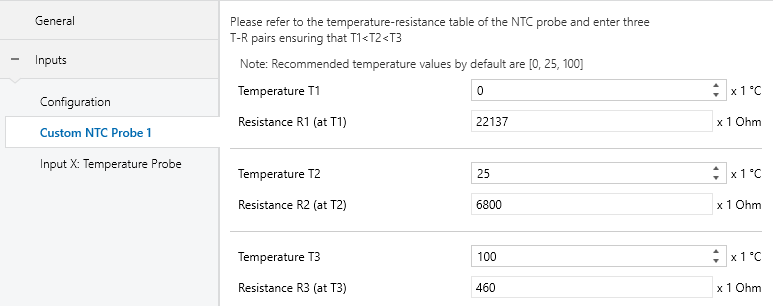
It contains the following parameters:
- Temperature Tx [-55…0…150] [x1ºC]: sets the temperature value of a particular point of the temperature-resistance curve.
- Resistance Rx (at Tx) [0…22137…268435456] [x1Ohm]: sets the resistance value of the that particular point of the temperature-resistance curve. In other words, this parameter sets the resistance value offered by the custom NTC probe for the above temperature value.
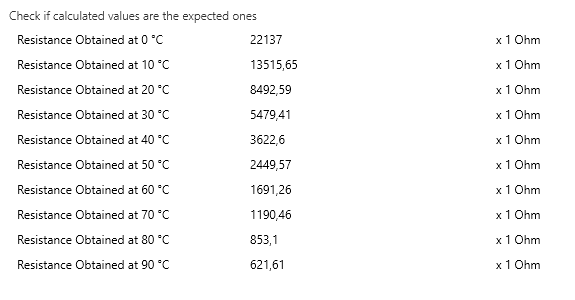
After defining the three {Temperature, Resistance} points of the curve, it is advisable to verify the read-only values shown in the lower section of the screen (see Figure 5), as they reflect the expected resistance values (in Ohms) for a set of temperature values in the range 0ºC to 90ºC, according to the curve approximation performed by the device. In the case of a wrong parameterisation or if the points do not describe a typical NTC curve, ETS will show a warning message.
Important
These are general parameters – they apply to all custom NTC probes that may be configured in the device.